Showing posts with label a-guest posts. Show all posts

May 7, 2024

Sedona, Arizona; Guest Post: Discovering Sedona and the Arizona Desert: A 3-day itinerary

Guest Post

Discovering Sedona and the Arizona Desert: 
A 3-day itinerary

story and images by Iris Miller Stetson

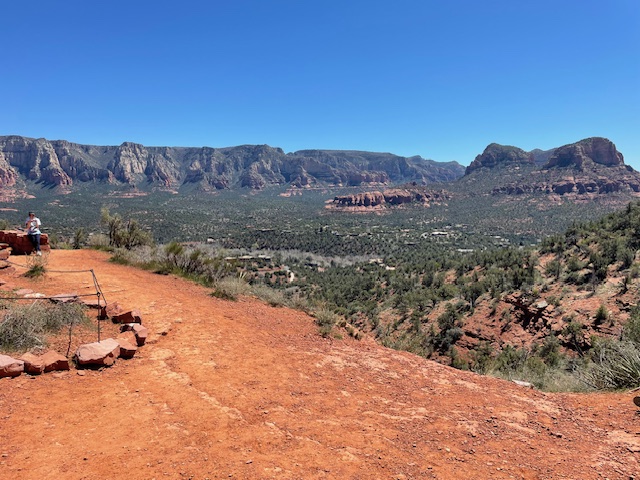
vista and rocky trail at beginning of hike on Airport Loop in Sedona, Arizona


Day 1

For years, I’ve heard how beautiful Sedona is.  I recently saw it for the first time with my life-long friend Susan, who I came to visit in Tucson.  She picked me up at the Phoenix Airport and we drove the 119 miles from there on to Sedona, which is quite a bit shorter than the 232 miles from Tucson.

As we approached Sedona, we saw red rock formations on the side of the road and knew we were near.

Though it was a Tuesday afternoon, cars were backed up for miles. While we were amazed by the beauty around us, we were horrified by the invasion of tourists. Sedona has about 10,000 residents, but it gets over 3 million tourists a year. We later learned from locals that Sedona is always overrun by visitors.

The Arizona Department of Transportation installed 12 roundabouts in the busiest part of town where most of the shops, art galleries, and restaurants thrive. It turns out they make it more challenging behind the wheel. Patiently, Susan kept us on the right road heading to the Sedona Southwest Inn, where we were booked for two nights.


Overnight Lodging in Sedona

Sedona Southwest Inn 

It was a challenge to find reasonable prices for lodging that provided two beds. During my online search I learned that most rooms were $600/night and up. We were pleased to find something that looked decent at $300/night. Located about a 10-minute drive from the center of town, our inn was quiet and the beds were comfortable, but I can only give it 3.5 stars (out of 5). It had a worn and tired feeling, was motel-like, and our room was not tidied after the first night.  But the price included breakfast and, though nothing special, it was adequate. 


Shopping in Sedona

TlaquepaqueArts and Shopping Village 

Once settled in our room, we ventured out to the nearby Tlaquepaque Arts and Shopping Village. Though very touristy, I appreciated that this large outdoor mall is decorated in the style of its surroundings. But the prices were shocking. A visitor sitting outside a candy shop who was eating a small ice cream scoop pointed to the shop and exclaimed, “Their prices are ridiculous! Over $5 for this little scoop!!" I went into the candy shop but saw nothing that looked good enough or special enough to splurge. We then wandered into a shoe store and a few other shops and the prices reminded me of back home in California where everything is over the top. A lot of the shops at Tlaquepaque are nice, but nothing stood out. However, the weather was great so it offered a pleasant place to sit, browse, and walk around.


Dinner in Sedona

American Creekside Bistro 

Owned by the same folks who run the Mesa Grill, another well-known Sedona eatery, the American Creekside Bistro can be quite busy. Book dinner reservations in advance. Since we arrived early, I had time to wander around the Creekside Plaza where the bistro is located. It’s full of shops catering to those who come to Sedona for the vortexes. Sedona has lots of tours and stores just for those who visit in search of crystals, spirituality, and the promise of renewed energy from the assumed magic of a vortex. 

Like most of the places we went to, The American Creekside Bistro is very casual and the food is good. We shared an appetizer of Ahi Tuna Nachos made with spiced wonton chips, spicy aioli duo, mango, fresh ginger, and avocado. The main course was Parmesan Crusted Chicken Breast with lemon caper butter, asparagus, whipped potatoes, and dessert was a huge warm Peach Cobbler with caramel ice cream and whipped cream--this was one of the rare times that I couldn't finish something sweet. Overall, the food was plentiful and tasty, and since we shared everything the tab was extremely reasonable.

Peach Cobbler dessert at American Creekside Bistro in Sedona, Arizona


Day 2

A hike in Sedona

Sedona Airport Loop Trail   

After breakfast the following morning, we took road 89A to the Airport Road. This takes you to the Airport Vista Parking Lot where you can park for $3, cross the road and gaze out to incredible views from the Airport Scenic Overlook. 

Susan doesn’t hike but I do, so she sat at the lookout while I crossed back to the parking lot and found what I thought was the beginning of the Airport Loop Trail. I viewed a map but couldn’t determine how long the hike would be. I was wearing new hiking shoes with a good grip, my sun hat, jeans, a T-shirt, and light jacket. I had my phone and some cough drops but not much else. It was 11 a.m., and the temperature was in the 60s with a high expected in the low 70s. I’m used to walking 4 to 5 miles each day and, in my excitement to walk on the red earth and see the Sedona I came for, I foolishly took off without any water or knowledge of the trail. 

The day and scenery couldn’t have been more beautiful. At first, I passed a lot of people going the opposite way, and a very nice woman asked if I wanted my picture taken, so I posed.

The trail began along the road, and as soon as it veered off I saw incredible red rock formations but realized I had to also watch the path since it was so rocky. I knew I couldn’t capture this kind of beauty in a photograph, but I kept stopping to shoot pictures anyway. The vistas were breathtaking. 

red earth in Sedona, Arizona


I called Susan to let her know I didn’t see any markers and did not know how long I would be. When I got to what I suspected to be the halfway point, there were markers. I stopped and rested, gazing at the incredible mound of red earth and formations before me. Many fellow hikers were doing the same thing.

One marker indicated .6 mile to the end, so I called Susan again to let her know, that given the terrain, I expected to be back in an hour or so. It was noon.

As I journeyed on, the trail seemed to get rougher and more precarious in a number of places where the edge narrowed. There were slanted, slippery-looking rocks that I had to cross so I slowed down on those and carefully moved on.

cacti along Airport Loop Trail in Sedona, Arizona


I met many trailblazers. There were parents with children, and people with dogs on leashes.  I was often asked how I (a 76-year-old) was doing. I felt cared for by my fellow nature lovers. At various points, I’d ask people if they knew how much farther the trail went but no one did. Maybe we were all lost? And I kept thinking, “How on earth could I start out without water and not knowing how long this would take?" Then, I met the nicest woman with her husband and two boys. They offered me food and water. I accepted the water, and the woman said they’d be behind me. Somehow, I lost them, but in between calls to Susan I’d stop to look at the cacti and take short breaks under small trees that offered a little shade, where I’d drink a few sips of my precious water.

rocky trail at beginning of hike on Airport Loop Trail in Sedona, Arizona


At one point, I was a little worried that I might be lost, but then I crossed paths with a woman who told me to look for a wire fence that led to the end and that it wasn’t far. I came close to two female deer and a very large buck. I’m used to deer and knew they’d run away from me, which they did. After that, I saw a slight fork in the road and came upon the wire fence. Soon, I heard people talking and saw houses on the other side of the fence. There was no marker, but I noticed a small gravel path that led up to a road. I followed it and found myself near the Airport Scenic Overlook, right across the street from Susan, who was waiting in her car. It was 1 p.m.

After gratefully rejoining my friend, and sitting for a few minutes and drinking more water, I visited a convenient porta-potty in the parking lot. On the way, I ran into the wonderful woman who had offered me food and water. We hugged as she exclaimed, “You made it!” There were so many guardian angels on the trail that day, all seeming to watch out for each other.
summit of hike on Airport Loop Trail in Sedona, Arizona


I know some people venture out on the Airport Loop Trail to see the sunset.  If you do, be prepared with flashlights, good directions, warm clothes, good shoes, food, and water. Rattlesnakes don’t come out until the end of April, and I didn’t see any lizards or jack rabbits, but make sure you’re well equipped.

Since my adventure, I’ve researched the trail.  I have found varying lengths, but I think it was about 4 miles, including that .6 mile which is the back end of the loop. I’ll never forget this experience. I was never scared—it’s too beautiful and demanding for that--though I am sorry to have alarmed my friend. If you visit, take in as much of the magnificence as you can, but don’t forget to pack along some water!


Lunch in Sedona

Indian Gardens CafĂ© and Market 

After my adventure, we headed to the Indian Gardens in Oak Creek, a lovely neighborhood away from the center of Sedona. It has a very pleasant outdoor patio, and the lunch menu offers sandwiches, salads, and other typical cafe fare. We shared a vegetarian sandwich and salad. The food was good and the prices reasonable. After, we visited the shop next door, Garland’s Indian Jewelry, where we browsed a wealth of beautifully crafted Native American baskets, jewelry, leather goods, vases, Kachinas, and etc.  


Jeep tour in Sedona

Arizona Safari Jeep Tours

We scheduled a jeep tour at 5 p.m. Though the Sedona Pink Jeep tours were sold out, we found a tour with Arizona Safari Jeep Tours. All their tours have ratings, like rugged, easy, etc., so we booked appropriately. Our tour from 5 to7 p.m. gave us a chance to see the color changes that come to the canyon at sunset. 

Our tour guide took us into Boynton Canyon. He explained how the red rock and earth of Sedona comes from the rust, or iron oxide, that formed from over 300 million years of volcanic eruptions and weathering of the elements. There is a high amount of iron oxide in the Sedona soil, which produces the red color. When combined with large deposits of quartz, this creates an enormous amount of magnetic energy in the area, and many people believe that this kind of energy is centered in the vortexes. Our guide stopped the jeep and used metal rods that bent down when they were hovering above an iron oxide and quartz rock, demonstrating the magnetic pull. It was fun and, as the sun began to set, we saw the red hills change to a beautiful golden hue.


Arizona Safari Jeep Tours in Boynton Canyon in Sedona, Arizona

Dinner in Sedona

Saltrock Southwest Kitchen    

After our jeep tour, we headed to dinner at Saltrock Southwest Kitchen at the Amara Resort & Spa. It’s upscale, but people dress casually. We sat outside, hoping for a clear evening to look up at the stars. But it was chilly. The accommodating staff brought us a heat lamp and warm blankets to wrap up in. There were no stars, but the excellent food included Blue Crab Empanadas, a Tiger Shrimp Tamal, and a fantastic Poblano Relleno. Again, sharing made the price for such good food and service quite reasonable. Try to eat here during the day when you’ll enjoy a fantastic view.


Day 3

Jerome, Arizona

glorious sky and Susan in Jerome, Arizona
glorious sky and Susan Eisen in Jerome, Arizona 


We left Sedona the next day and headed to nearby Jerome. Once a booming copper-mining town, its population now is about 450, and it’s sometimes referred to as a ghost town. The sky here is glorious; it is right up there with the best sky I ever saw in New Mexico.  Streets wind around on hills filled with shops that remind me of the hippie days. Parking is difficult, so we wound up heading back to Tucson for lunch.


Iris Miller Stetson on Airport Loop Trail in Sedona, New Mexico
Iris Miller Stetson on Airport Loop Trail in Sedona, Arizona

Iris Miller Stetson lives in Oakland, California. An avid nature lover, she enjoys gardening and daily hikes. Iris is the author of “The Voice of Acceptance: A True Story About Abuse, Disability, and the Pursuit of Happiness”.


More places to visit in Arizona.

More ideas for exploring the U.S.


November 13, 2019

Guest Post: Tour the Statues at West Virginia's State Capitol

Guest Post

Tour the Statues at West Virginia's State Capitol

by Renate Pore
images ©2019 Carole Terwilliger Meyers

THE CAPITOL


The classical-style West Virginia State Capitol sits on a scenic site facing the Kanawha River.  The building was constructed in three stages between 1924 and 1932, and is one of the most beautiful and impressive buildings in West Virginia.  The architect behind it was Cass Gilbert, who also designed the U.S. Treasury Annex and the U.S. Supreme Court in Washington.  The top of the building is graced by a shining dome of 23.5 carat gold leaf.  At the time of my visit, the dome was wrapped in plastic for repairs.  If you visit, don’t expect to see the dome in all its shining glory until 2021.

Also located on the State Capitol grounds are the History Museum and Governor’s Mansion.  The Great Hall of the History Museum displays hand-made quilts in honor of the state’s tradition of quilting and other folk art.


THE STATUES


General Stonewall Jackson statue at the West Virginia State Capitol in Charleston
General Stonewall Jackson statue
at the West Virginia State Capitol in Charleston


#1 
A jaunty General Stonewall Jackson stands on the lawn of the West Virginia State Capitol.  Jackson was born in western Virginia and won fame fighting for the Confederacy even though his home would be one of 55 counties seceding from Virginia to join the Union Cause.  Commissioned in 1910 by the Daughters of the Confederacy, the statue was created during the Jim Crow Era when states and localities were passing laws to enforce segregation.  Because of its association with a shameful period in the nation’s history, there have been some calls to remove the statue from its place of honor and relegate it to the State Museum.  So far, however, Stonewall Jackson still stands.


“Abraham Lincoln Walks at Midnight” statue at the West Virginia State Capitol in Charleston
“Abraham Lincoln Walks at Midnight” statue
at the West Virginia State Capitol in Charleston

#2 

“Abraham Lincoln Walks at Midnight” is another statue commemorating West Virginia’s Civil War history.  It stands on the south side of the State Capitol and shows a grieving President Lincoln, sleepless because of the pressing burdens of the Civil War.  West Virginia became a state in 1863 because the people of western Virginia identified more with the North than with the slaveholding confederate states of the South.


#3

On the west end not far from Stonewall Jackson stands the statue commemorating 32,000 soldiers, sailors, and marines from West Virginia who fought for the Union cause in the Civil War.  Some years ago when the bronze statue was repaired, it was coated with a plastic substance which gives it its orange look. The strange hue was very upsetting to the locals who were used to the seeing their statues in greenish bronze.


coal miner statue at the West Virginia State Capitol in Charleston

#4

West Virginia is coal, and coal is West Virginia.  A burly coal miner in a hard hat graces the northwest side of the Capitol.  The base of the statue depicts scenes from the coal-mining era--from the days of pick and shovel to continuous miners.  Today, coal mining is a dying industry and coal miners are working-class heroes from another time.  About 13,000 people continue to be employed in underground or mountain-top-removal mining.


Veteran’s Memorial at the West Virginia State Capitol in Charleston

#5

The West Virginia Veteran’s Memorial is a two-story oval monument honoring more than 10,000 West Virginians who made the ultimate sacrifice in defending the nation in twentieth-century conflicts.  Composed of four limestone monoliths surrounded by a reflecting pool, the interior walls are faced in polished black granite etched with the names of these men and women.  The Memorial was designed by P. Joseph Mullins, who also sculpted the four figures representing the four major twentieth-century conflicts and the four major branches of military service.  The statue in the photo depicts a sailor from World War II.


“West Virginia’s Female Veteran” statue at the West Virginia State Capitol in Charleston
“West Virginia’s Female Veteran” statue
at the West Virginia State Capitol in Charleston

#6

The “West Virginia’s Female Veteran” statue is also part of the West Virginia Veteran’s Memorial described in #6.   The statue of the woman warrior was the last piece added to the memorial.  It became controversial when the sculptor decided to depict the woman in fatigues.  Female veterans wanted a statue showing a woman in dress uniform.  To accommodate everyone, engraved copper plates around the base of the statue depict women in more formal dress.


Booker T. Washington statue at the West Virginia State Capitol in Charleston

#7

This statue of Booker T. Washington stands on the north side of the State Capitol. Booker Taliaferro Washington lived about 10 miles southeast of Charleston in Malden, West Virginia.  He was an educator, author, orator, and advisor to United States presidents.  The last of the black American leaders born into slavery, he became a leading voice against the oppression of former slaves and their descendants during the Jim Crow Era.


Anna Jarvis bust at the West Virginia State Capitol in Charleston

#8

This bust of Anna Jarvis stands next to the information desk on the main floor of the West Virginia State Capitol.  Jarvis grew up in Grafton, West Virginia, and is credited as the founder of Mother’s Day in the United States.  After the death of her mother, she organized an aggressive campaign to establish a National Mother’s Day, and thanks to her efforts, by 1911 almost every state in the nation was celebrating Mother’s Day.


guest blogger Renate Pore

Renate Pore migrated from California to West Virginia in the late 1960s.  Although there is no place like California, Renate got hooked on West Virginia--the semi-rural life style, the mountains, the breathtaking spring when all the trees suddenly burst out in bloom and the serene days of fall when the weather is just like California.  Renate felt West Virginia could use her skills and talents and has had a long and satisfying career as a health care activist badgering federal and state  policymakers to do the right thing on health care.  Renate is retired now but working on events to celebrate the Centennial of the 19th Amendment--women's right to vote--and its ratification in West Virginia.  She is a political junkie and looks to California to lead us to a new and better place.  Renate lives in Charleston with her sweet, shaggy, red-haired boy, Ollie.


More things to do in Charleston, West Virginia.

More ideas for travel adventures in California and the U.S. and around the world.

updated 4-3-21


September 18, 2019

Lhasa, Tibet: Guest Post: Top 5 Things to Do in Lhasa, Tibet

Guest Post

Top 5 Things to Do in Lhasa, Tibet

by Yolanda O’Bannon and Lobsang Wangdu
images ©2019 Yolanda O’Bannon and Lobsang Wangdu


Lhasa, Tibet is like no other place on earth.  Incredibly, despite more than 60 years of sinicization and systematic repression, Tibet is still powerfully, beautifully Tibetan, and you can still have an unforgettable experience in the Tibetan capital.

But you’re probably wondering:  “How do I see the real Tibet, and not some Disney version of it?”  We’re going to make that easy for you.  If you want to maximize your time with Tibetan people, to rub shoulders with nomads and pilgrims and normal Tibetan folk, just follow our top 5 things to do in Lhasa.

Let’s dive right in . . .


#1 Visit the Jokhang Temple with Nomads 

If you visit only one site in Lhasa, it should be the Jokhang Temple.  Located in the center of the old town of Lhasa, the Jokhang is home to the most sacred statue in the Tibetan world.  The Jowo Rinpoche is an image of the Buddha Shakymanuni when he was 12 years old.

The Jokhang Temple is also at the center of a cluster of ancient temples in Lhasa, and in many ways it represents the spiritual center of Tibetan Buddhism.  Tibetans from all over Tibet make pilgrimages to the Jokhang and crowd its dark, narrow, wildly-colorful chapels and hallways.

Don’t miss the upper floors and the roof, from where you can sometimes see monk debates.  And be sure to walk the kora just outside the Jokhang, a passageway lined with prayer wheels where you can join local Tibetans in the soothing and companionable hum of prayers.  More on koras below . . .

Jokhang Roof in Lhasa, Tibet


Jowo Shakyamuni Statue at Jokhang in Lhasa, Tibet


#2 Rub Shoulders with Local Tibetans on the Koras

Tibetans habitually create prayer paths around holy spots (known as koras), and since Lhasa is chock full of holy sites, there are endless koras you can participate in.  Tibetans believe we develop spiritual merit by circumambulating a holy spot, particularly if you do so with a strong motivation of generating spiritual wisdom and compassion.  Here are some of the most popular ones;

The Barkhor

The Barkhor is the prayer path that circles the Jokhang Temple complex and is a hugely popular place in Lhasa for Tibetans to gather and do a lap or two at any time of the day.  There are endless market stalls bordering the Barkhor.  Though in recent years, the smaller, older carts and stalls have disappeared, you can still find many Tibetan vendors here, selling just about anything you could want--from prayer scarves to Tibetan clothing to statues to socks.  You can come back multiple times a day and never be bored on the Barkhor.

Bonus tip: The correct way to circle a kora is clockwise, unless you are a Bon practitioner, in which case you circle counter-clockwise.  You’ll note the great majority of Tibetans are Tibetan Buddhist and circle clockwise.

Barkhor Kora in Lhasa, Tibet


Potang Shakor

Another major kora site is around the Potala Palace.  Like the Barkhor, the Potang shakor (the kora around the Potala) is full at any time of day with local Tibetans doing their prayers, catching up with friends, or stopping by on their way to somewhere else.

When you circle the Potang shakor, you flow past the interesting back of the Potala palace, with stupha sites, a small lake and park, and the lovely little Lukhang Temple situated in the lake.

Potala Palace in Lhasa, Tibet


#3 Join Tibetan Pilgrims at the Drepung Monastery

Lhasa is home to many major monasteries, and you can spend days exploring any of them, but if we had to pick one not to miss, we’d go with Drepung.  It is the largest of Tibetan Buddhist monasteries, and at one time held upward of 10,000 monks, though today it is a shadow of its former self, with less than 500 monks.

Don’t miss the holiest statue at Drepung, the 50-foot-tall image of the Maitreya Buddha.  Follow the Tibetans as they flow through the chapels, and you are welcome to join the line if you come across a monk offering holy water.

If you have time, walk the kora around the whole temple complex, more like a hike, with great views over the city and beautiful little colorful clusters of prayer flags and rocks engraved with prayers like “om mani padme” hung along the way.  After, you can take the approximately 15-minute walk down the hill to Nechung Monastery, home of the Nechung Oracle.  It is fascinating, if a bit on the creepy, dark side.


#4 View the Private Quarters of the Dalai Lama’s at the Potala Palace

The spectacularly beautiful Potala Palace sits high above the center of Lhasa.  Its massive, but elegant, lines will be etched in your mind forever after you leave Lhasa.  Formerly home to generations of Dalai Lamas and huge, vibrant communities of monks, it is now a sad, empty shell--a lifeless museum.

And yet, it is precious to Tibetans because it was, most recently, the home of the 14th Dalai Lama before he was forced to flee Tibet in 1959.  Along with streams of other tourists and local Tibetans and pilgrims, you can still see His Holiness’ private quarters at the top of the Palace.  Everyone huffs up the endless, steep stairs and ladders to reach those higher floors.

Tip:  Don’t do this on your first day--give yourself time to acclimatize to Lhasa’s altitude.


#5  Sip a Cuppa with Old Tibetan Ladies at Local Tea Shops

Lhasa folk love their tea--Tibetan butter tea (po cha) and sweet milk tea (cha ngarmo)—and they love to sit and have a cuppa in a tea shop.  If you wander the narrow streets around the Barkhor, you will come upon plenty of little tea and noodle shops.  To pop in and take a load off with some local old ladies and school kids is as real as it gets.


If you do just these five things while you’re in Lhasa, we promise it will be an experience you will never forget.

Are you ready to travel to Lhasa?


authors Yolanda O’Bannon and Lobsang Wangdu

Authors Yolanda O’Bannon and Lobsang Wangdu are Tibet travel experts that help make Tibet travel more simple, safe, and ethical via their website, YoWangdu Experience Tibet.  At the website, visit the informative page “How to Visit Tibet: An Insider’s Guide” for practical guidance for your own trip.

More ideas for exploring Asia and the South Pacific.


February 26, 2016

NYC; Guest Post: We loved New York even more with a CityPASS

Guest Post

We loved New York even more with a CityPASS

by Connie Terwilliger, with Debbie Murray
images ©2016 Debbie Murray


at Mews near Washington Square, Big Storm of 2016, NYC


On a late January trip to NYC with my sister, Debbie, to visit our niece and her new family members--identical twin girls—in Queens, we decided to explore Manhattan for a couple of days first.  Turns out, we had the experience of our lives when we encountered one of the biggest snow storms in NYC history.   Because that evening of the storm it had been outlawed to drive cars or taxis or buses--even the subway  was closed—adults and dogs as well as kids were playing in the streets in the snow.  Everyone hung around their homes and threw snowballs.  Amazingly, policemen were still out there patrolling.

But, being tourists, we forged on with our plan to use our CityPASS to save some money and effort on our adventures.  However, because of the exceptional conditions presented by this major snow storm, we didn’t do as much or save quite as much as we had anticipated.


The Metropolitan Museum of Art 

I was impressed with how efficient and quick it was to get our passes approved for entry.  The regular charge for admission is a voluntary donation, so in essence this museum is free, but the recommended donation is $25 and most people pay that.   With the entry sticker attached to your clothing, you can come and go for the entire day.
Connie’s favorite exhibit:  Contemporary Art section
Debbie’s favorite exhibit:  room devoted to Frank Lloyd Wright

Frank Lloyd Wright room at Metropolitan Museum of Art, NYC


Solomon R. Guggenheim Museum 

Here, we got to go to front of line with CityPASS—quite a handy feature when the museum just opens and it has a long line.  Unfortunately, the museum was redoing the central spiral ramp so we were unable to walk there, but the exhibits we did see were impressive.  Admission is $25, but because the museum wasn’t fully open it was discounted that day.  More about the Guggenheim.
Connie’s favorite exhibit:  the Kadinsky paintings 
Debbie’s favorite exhibit:  the Kadinsky paintings

Kadinsky painting at Guggenheim Museum, NYC


Empire State Building Experience

By chance, we chose an amazing time to visit here—5 p.m. on a Sunday, and a day after the second biggest snow storm in the history of NYC.  Consequently there was absolutely NO line.  We could tell that the line must generally be long, because it took us a good 10 minutes to “walk the line” to the elevator to take us to the 86th-floor viewpoint.  It was a clear night, and there were perhaps 80 people viewing the sites.  I am sure I wouldn’t have done this if I’d had to wait in a long line, but I definitely would have if CityPASS had taken me to the front.  The normal admission charge is $30; $60 for skipping to the front of the line.

sunset from atop Empire State Building, NYC


American Museum of Natural History 

Debbie says:  I went here alone the day after the snow storm.  I arrived at about 2 p.m. and there was no line, but the pass did permit me to go to the front of the members’ line.  Because some areas of the museum were closed, the ticket desk didn’t want to take my pass then, so that I could come back again on another day.  Admission here is $22. 
Debbie’s favorite exhibit:  the dinosaur skeleton in its own room on the main level

dinosaur skeleton at American Museum of Natural History, NYC


Debbie says:  Though due to the snow storm we were unable to do everything we’d planned, the storm was my favorite part of the trip in Manhattan.  Visiting my niece and her new twins were the best treat in Queens.  I want to go back to NYC again in December for Christmas.
 
Connie says:  If you’re planning to visit from three to five of the places on the CityPASS, it’s well worth any extra cost just to get to the front of the line!  Originally we were planning to visit all of the places in the CityPASS booklet, including the “Top of the Rock” Observation Deck at Rockefeller Center, but we were slowed down a bit by the storm.

image ©2016 Suzanne Flores


Note:  CityPASS provided two New York adult booklets ($114 each) for this adventure.  You can buy your pass booklet at any listed attraction; it is valid for 9 days.  


Connie Terwilliger is the author of “Art Travel Guide” and the operator of The Art Cottage & Art Studio overnight lodging in Nevada City, California.


December 21, 2015

Guest Post: Honeymoon in Bali, Indonesia

Guest Post

Honeymoon in Bali, Indonesia

photos by Greg Murray, Natalie Murray, and anonymous


sipping coconut water in Bali

Kuta

The Kuta Angel Hotel was nice, clean, modern/trendyish boutique hotel.  Nothing too crazy or special.  We were only there a night so just went to dinner on the main strip and the beach in the morning.

Nusa Lembongan
We stayed at the Mushroom Beach Garden Rooms.  We didn’t like it there and found ourselves hanging out at the Hai Tide Beach Resort.  We took a motor scooter for half a day ($4) and went to the bridge, which was fun.  Ate at Mama Mia, which was good and quite an experience.  Drive across if you are feeling adventurous.  We also went up to the other part of the island and would recommend searching for a better hotel there and checking out The Deck Cafe Bar, tho that north west strip of beach is a bit more “local.”  We went snorkeling off the north tip of the island which was great--warm water beautiful fish and coral.  From there the captain took us to the channel in between the islands, dropped us off, and picked us up a mile downstream.  That was also fantastic, being taken by the current, and a must do.  However, the water was cold.


Tegalalang

We stayed at an Airbnb here only for a night and it was a highlight of the trip.  The rice terraces were beautiful, and we hiked through them in the morning.  We drove a scooter an hour up to an outlook of Lake Batur for dinner.  Timing was perfect and though the restaurant we sought was closed, we went next door and had the place to ourselves, as well as a candidate for the best fish I’ve ever eaten.  For a measly 50IDR (about US$4).     

fish dinner in Tegalalang, Bali


Ubud

We stayed right next to the monkey forest at the Pondok Pundi Village Inn.  It was clean but no mosquito nets in the room and lots of mosquitoes.  I stayed up drinking arak (the local alcohol), hunting them all.  We did not get bit that night.  ;)  The monkey forest was fun, and we took our time through it as it is small.  I'd recommend the Three Monkeys Cafe.  We found mie goreng (a popular noodle dish) to be our go-to meal, and it was great here, along with a very good burger.

monkey forest in Ubud, Bali


monkey forest in Ubud, Bali


Candidesa

We stayed at an Airbnb here too, but there were a couple “OK” bungalows in this area but don’t know the names.  Otherwise, maybe the Bloo Lagoon hotel a little farther south.  We had dinner at sunset on the beach at Lezat Beach Restaurant.  It was great.  We took a scooter in search of a waterfall, but the waterfall turned out to be a water palace … still cool.  Then we went to the virgin white sand beach.  The beach was nice but kinda a bust for us as we wanted peace and solitude.  Then we went snorkeling at Blood Lagoon.  It was very pretty, and the fish were very friendly.  Then we went off the coast a little bit to some rocks where a turtle hangs out.  The water was deeper and not as colorful, but the water was also rougher and scarier and I loved it.  It was one of my fav snorkeling spots.  And we saw a turtle.   

sunset drinks in Bali


South Kuta

Ayana was beautiful.  The Rock Bar there was great, not your “Bali experience" tho.  But if you are looking for western comfort and Instagram famous … this is it.  You will find you need to go to the lobby for internet tho.

hanging in the pool at Avana resort in South Kuta, Bali


Rock Bar at Avana resort in South Kuta, Bali


We took the local transportation services that are on every corner for our longer trips.  The prices are set and cheaper than the pesty guys that solicit.  Natalie and I both agreed if we were to do it again, the only way to go would be backpacks and a scooter.  And if we had two kids, we would get two scooters.  If you want luxury, you can find it, but you will have to close your eyes often, especially on the trip from the airport to the hotel.  Natalie left hers open and was concerned for our safety.  For some reason, we didn’t get that memo.  But everyone was so nice and hospitable in the end.  We didn’t use any bug spray or get any inoculations.  The food was surprisingly good.  We had two plates (and a large Bintang beer) made and served by a 12-year-old for 75IDR (about US$6)!  


More things to do in Bali.

March 2, 2015

Guest Post: Honeymoon in Cambodia: An inside peek into a Buddhist Water-Blessing Ceremony

Guest Post

Honeymoon in Cambodia:  An inside peek into a Buddhist Water-Blessing Ceremony

story and images by Suzanne Flores

During our honeymoon in Cambodia, my husband and I had the rare opportunity to experience a traditional Cambodian Buddhist water blessing, a sacred ritual for cleansing and good luck that dates back to ancient times.  While the ceremony is not exclusively meant for newlyweds, it’s an ideal experience for honeymooners seeking a unique and “out-of-the-box” way to bless this important commitment…as long as being splashed with (a lot of) water is not a deal breaker!   More . . . 


More ideas for exploring Asia and the South Pacific.


May 16, 2012

Guest Post: See The Amazon in Peru with Aqua Expeditions

Guest Post

See The Amazon in Peru with Aqua Expeditions

story and images by Suzanne Flores

Travel professional and daughter of mine, Suzanne Meyers, recently returned from a trip with Aqua Expeditions on the Amazon in Peru.  Here are some of her observations:


During a recent trip aboard M/V Aria in the Peruvian Amazon, our group made a visit to a local village where we were greeted by a large group of eager children.  They were ecstatic to see us and hopeful that we had gifts in tow.  The village is one of about 20 in the area that Aqua Expeditions supports and visits on a regular basis.  


This girl was very adamant to have her picture taken, and she was ready to strike a pose!


A rare opportunity occurred.  The village shaman was present when we visited and agreed to teach us about the properties of various medicinal plants (he spent 10 years in the Amazonian rain forest in order to become an official shaman).  I lucked out and was given a spiritual cleanse!


More things to do in Peru.

More ideas for exploring South America.  


Popular Posts